
Signal Wizard Systems


Note: This system is also known as Signal Wizard


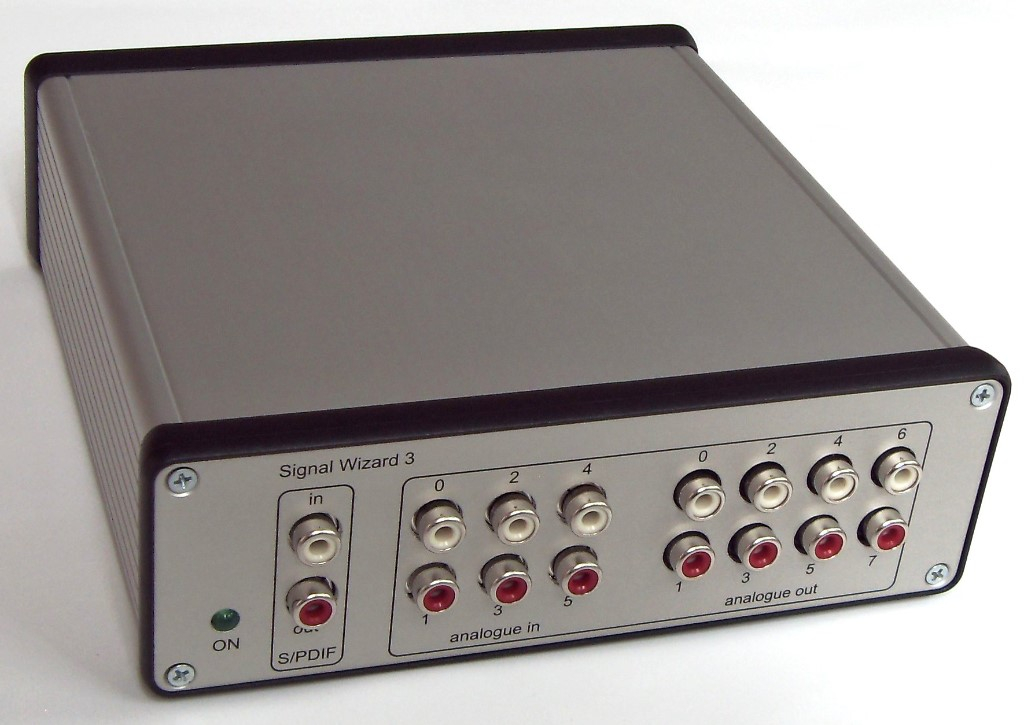
Signal Wizard is a unique, integrated system for designing, downloading and running very high performance filters in real-time. It includes the high-level PC-based software interface that designs the filter according to the user's requirements, a hardware module based on an advanced digital signal processor and a low-level firmware operating system that implements the filtering operations. Once designed, an integrated software interface is used to download the filter to the hardware module via a serial link where it is executed on demand. Most important, the system requires no knowledge of digital signal processing (DSP) theory on the part of the user, or of the mathematics associated with digital filter design. The Signal Wizard is a total-solution package. Due to its flexibility, it is particularly well suited to the real-time processing of audio signals. High quality analogue signal conditioning and a stereo 24-bit resolution codec provide extremely high resolution, sufficient for the most demanding applications. In short, Signal Wizard brings the power of digital signal processing to any audio-bandwidth domain that requires electronic signal filtering. Applications include audio signal processing, sensor signal conditioning, signal analysis, vibration analysis, education and research in electrical, electronic and other physical sciences.


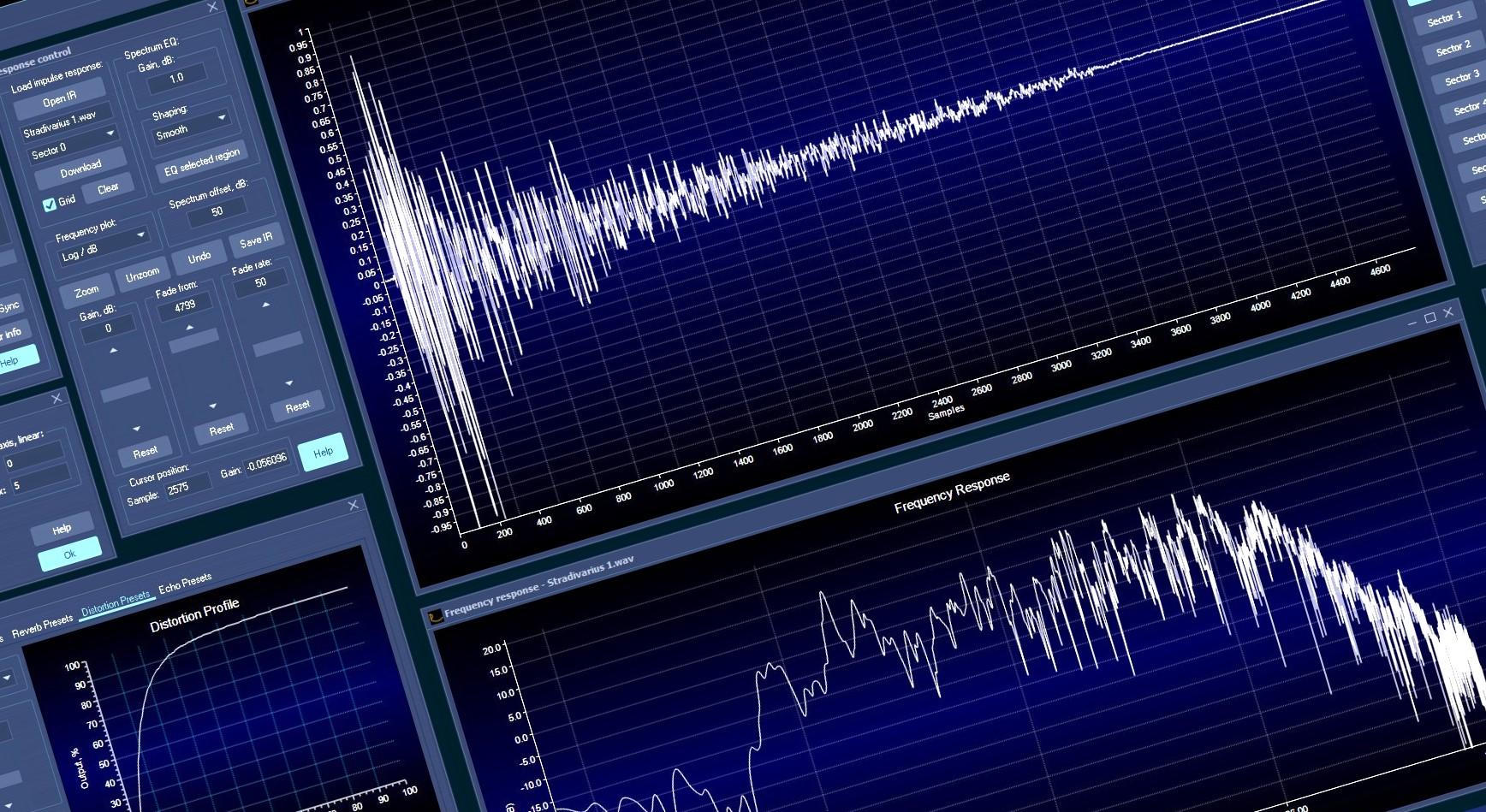
Low pass, high bass, multiple band-stop / band-pass filters may be combined to produce very complex filters for frequencies up to 24 kHz, as well as standard infinite impulse response (IIR) and adaptive types. The software can also accept measured responses to define a filter template. This can be used to provide measurement equalisation or to search out signal signatures in noisy environments. In fact, it is a simple matter to produce filters with completely arbitrary frequency magnitude and phase characteristics using the finite impulse response (FIR) method, with no phase distortion, no matter how sharp the filter is. Alternatively, arbitrary phase distortion can be introduced if this is desirable. It is even possible to design and execute real-time deconvolution (inverse) filters using the special invert mode. Because the processing module is so fast, it is possible to design filters with responses far beyond what is possible with traditional analogue techniques. The control program runs under Windows, and provides a user-friendly filter design tool that de-mystifies the process of specifying the filter. The filter design process simply becomes one of describing the desired frequency response. The design package indicates the response that will be produced and also the deviation from that specified. User designs may be stored for re-use and actual responses may be entered from measurements for simulation or equalisation purposes. The filters are calculated and downloaded to the hardware within seconds.


Real-time signal processing based on both general purpose microprocessors and fast digital signal processors is a technique that emerged in the 1970's, and is now widely considered one of the fastest growing application areas in the field of digital technology. Applications include biomedical signal analysis, image analysis, image coding and decoding, and audio signal enhancement. Typically for filtering, the analogue waveform is first digitized by an ADC, and the binary values are transmitted to a DSP device that filters them using an appropriate algorithm. The processed data are then sent to a DAC that outputs a filtered analogue signal.


Filters constructed using DSP technology offer many advantages over traditional analogue methods. Most important, they are inherently flexible, since changing the characteristics of the filter merely involves changing the program code or filter coefficients; with an analogue filter, physical reconstruction is required. Furthermore, they are immune to the effects of aging and environmental conditions, since the filtering process is dependent on numerical calculations, not mechanical characteristics of the components. This makes them particularly suited for very low frequency signals. For the same reason, the performance of digital filters can be specified with extreme precision, in contrast to analogue filters where a 5% figure is considered excellent. However, there are significant investments in terms of time and intellectual effort required to understand the functions and instruction set of a particular device, construct the system, and write the algorithms. This cycle can take many months. Contrast this with designing and fabricating a 2nd order analogue filter based on two resistors, two capacitors and one op-amp, a process that might take fifteen minutes. Perhaps for this reason, scientists and engineers who wish to use a particular filter will first attempt an analogue solution. DSP filters in contrast, tend to be used by individuals who are both familiar and comfortable with the art of DSP, in terms of the electronics, coding and mathematics.


Signal Wizard dispenses completely with this learning curve. In five minutes, you will be able to design and run filters that you might have thought impossible in practical circumstances.


Signal Wizard 2.5 Key Features:


·         Runs under Windows 98, Me, 2000, NT and XP.

·         FIR filters: Multiple pass, stop or arbitrary filters; impulse or frequency response import mode; Butterworth, Chebyshev filters (all major types) to any order; analogue passive networks; zero-phase distortion or arbitrary phase.

·         Rectangular, Bartlett, Hamming, Hanning, Blackman or Kaiser window functions.

·         Deconvolution (inverse) or flipped filter options.

·         IIR filters: Butterworth and Chebyshev filters (all major types); arbitrary (pole-zero placement); IIR to FIR translation.

·         Adaptive filters: true (dual input) adaptive filter, for broadband or narrowband noise cancellation.

·         True dual channel operation (independent filters in each channel) with 24-bit resolution.

·         Real-time dual channel scope and spectrum analyzer function with data capture.

·         Plots impulse and frequency responses as magnitude, dB, square, root, real, imaginary or phase. Log or linear frequency axis. Pole-zero plots and coefficient export.

·         Channel mixing and inversion.

·         Channel delays from 21 microseconds to 1.8 seconds.

·         Extensive filter analysis statistics.

·         Animate facility for tap adjustment.

·         Impulse and frequency responses exportable as text files for off-line processing and spreadsheet analysis.

·         Real-time gain and sample rate control.

·         Filter module holds up to 8 filters in non-volatile memory.

·         Stand alone filter operation on start-up or connect to PC.

·         Twelve sample rates from 48 kHz down to 4 kHz.

·         Echo mode.

·         Arbitrary function generator.

·         Sine wave generator.

·         Modulated sine wave generator.

·         Off-line filter option for wave files.

·         Maximum input and output level 2 V peak-to-peak.

·         Serial interface operating at 115.2 kilo baud (auto-selected).


Coming Soon: Signal Wizard 3


Sales (USA):                                      www.saelig.com

Sales (UK and Europe):                     www.kanecomputing.co.uk

Technical (USA): Brian Jones:           rcubedaznet@yahoo.com

Technical (UK): Patrick Gaydecki:      patrick.gaydecki@manchester.ac.uk


Download Signal Wizard 2.5


Download Signal Wizard 3 Diagnostic


Sound Clip Examples


DSP presentation. Download this package to see the power of real time and offline DSP.


Pure Technologies


Last updated:        31 July 2008


This site is still under construction